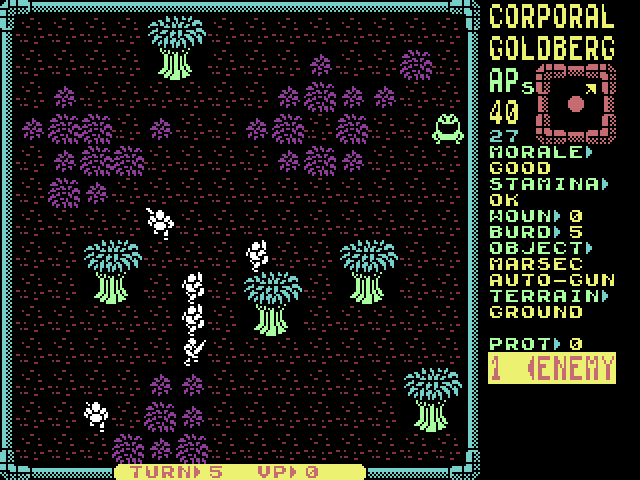
Laser Squad
Laser Squad is a turn-based tactical combat game for one or two players. Players buy weapons and armour, deploy their squad on a map divided into squares, and take turns moving and fighting.
Each soldier's action points limit how far they can move and how often they can fire. Facing and obstacles determine which enemies they can see. During the opposing turn, soldiers can use remaining points to fire at enemies moving within sight.
Remake
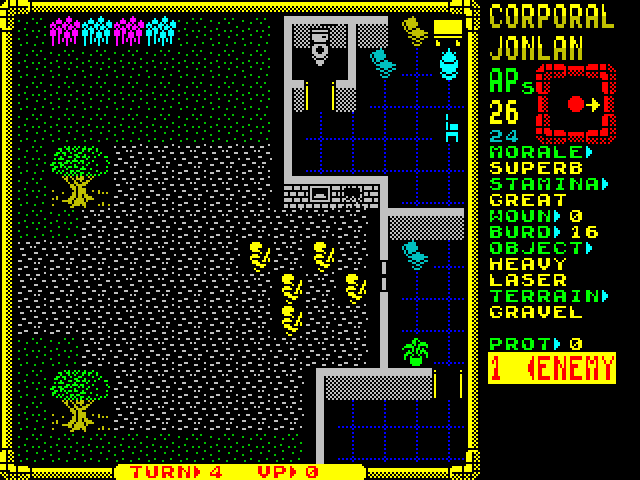
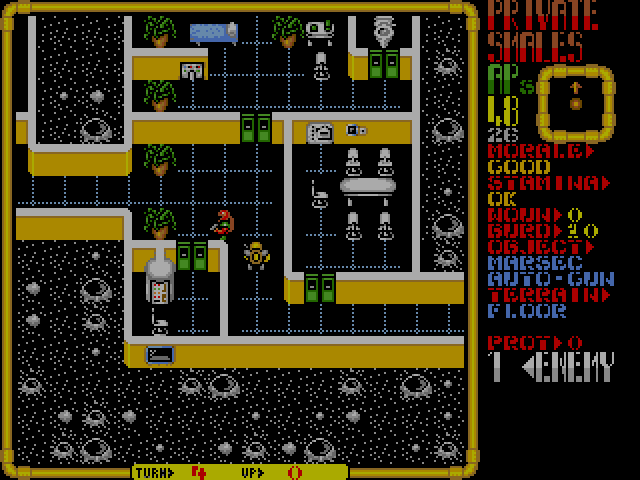
This remake was written from scratch. You can choose between the graphics and sounds of the Spectrum, C64 and Amiga originals. It runs on Windows, Linux, Steam Deck and MiSTer without an emulator. It also has a scenario editor and internet play, and players on different systems can play each other.
- Scenarios
- All seven from the original game.
- Players
- Single player, two players in hotseat, or two players over the internet.
- Graphics
- ZX Spectrum, C64 or Amiga graphics and sound, switchable during play. All three use the same rules. Amiga map graphics cover the first five scenarios; the last two use Spectrum tiles.
- Computer player
- Spectrum AI by default, with optional Extended AI in Options.
- Editor
- Edit maps, units, objects, pictures, briefings and computer player routes. Test changes without leaving the editor. See the editor instructions.
- Export
- Scenarios as a C64 disk (.d64) or Spectrum tape (.tzx) for the original game.
- Controls
- Keyboard, mouse or controller. Keys can be redefined.
History
Julian Gollop released Laser Squad for the ZX Spectrum through Target Games in 1988. His earlier Rebelstar Raiders (1984) and Rebelstar (1986) were inspired by tabletop wargames such as Sniper! and Squad Leader. He wanted the computer to handle the combat calculations that players otherwise worked out by hand.
In 1991, Julian and his brother Nick presented a Laser Squad 2 demo to MicroProse. The publisher wanted a game on the scale of Civilization. The sequel gained a global campaign, bases and research, and was released as UFO: Enemy Unknown (X-COM: UFO Defense) in 1994.